 bbauer@beinj.com
 609-587-6322


A build-out is really a long sequence of decisions that all land on the electrical system. Where the utility service enters, how much capacity the building can support, where switchgear and panel boards sit, how cable runs above the ceiling, how much light reaches a workstation. When those decisions get split across an engineer, a general contractor, and a specialty trade, the gaps show up later as change orders, rework, and delayed inspections.
A full service commercial electrician closes those gaps by owning the electrical scope from the first drawing to the final walkthrough. That means planning and engineering support, power distribution equipment, cabling, installation, testing, and the documentation that proves the work complies with code.
What a Turnkey Electrical Contractor Actually Handles
A turnkey electrical contractor works under one contract with one point of accountability. Instead of bidding only the wire and conduit after the drawings are frozen, that contractor participates in design coordination, sizes the service, selects distribution equipment, and then installs what was specified. The same team stays through testing and commissioning, so nothing gets lost in a handoff.
On a commercial or industrial build-out, a full service electrical scope usually covers:
- Design assistance and review of electrical drawings and load calculations
- Service entrance work and coordination with the utility
- Procurement and installation of switchgear, main distribution panels, and panel boards
- Branch circuit wiring, feeders, conduit, and cable management
- Lighting systems, controls, and lighting layout
- Low-voltage cabling for data, security, and building systems
- Testing, labeling, energization, and as-built documentation
Why the Electrical Scope Belongs in the Planning Stage
Electrical capacity is one of the hardest things to change later. If the incoming service is too small for the planned equipment, the fix is not a simple swap. It can mean new equipment, new conductors, and a longer conversation with the utility. A contractor involved during planning can flag a service that will not carry the load, recommend a different distribution layout, and identify long-lead equipment before it becomes a schedule problem.
Those conversations cost very little before concrete is poured. The same conversations are expensive after ceilings are closed and tenants are scheduled to move in.
Managing Power Coming Into the Facility
The electrical system starts where power enters the building and works outward to every receptacle, fixtures, and equipment. Getting the entry point right keeps everything downstream predictable. Three pieces of equipment do most of that work, and all three belong in a single contractor’s scope.
Main Distribution Panels
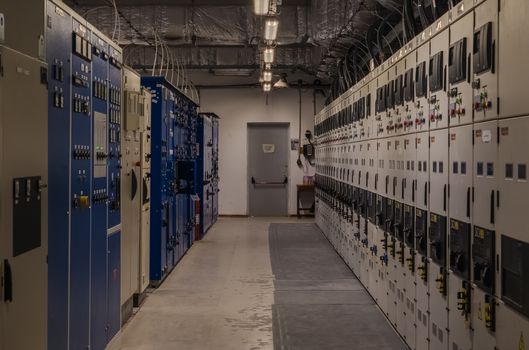
The main distribution panel is the first stop for power after the service entrance. It receives the incoming feeders and divides power into the larger circuits that serve the rest of the building. Its size, bus rating, and breaker configuration set the ceiling for how much the facility can ever use, so it has to be matched to both the current build-out and reasonable future growth.
Switchgear
Switchgear protects and controls the larger circuits. It houses the switching and protective devices that isolate faults, and it is usually where utility coordination, metering, and grounding come together. Industrial projects often need switchgear rated for motor loads and higher fault currents than a typical office tenant would ever see. Installation sequence matters because switchgear is heavy, arrives on its own schedule, and needs clear working space for service access.
Panel Boards
Panel boards take power from the larger distribution and break it into the branch circuits that serve lights, receptacles, equipment, and dedicated systems. Where they are located affects both cost and convenience. A panel board placed in the right mechanical room with proper clearances makes future tenant work straightforward. One buried behind finished walls creates a problem with every change.
Cabling and Rough-In: Coordination That Saves Rework
Cabling is where a build-out either flows or stalls. Feeders, branch circuits, conduit, cable tray, and low-voltage pathways all compete for the same ceiling space, and the order they go in determines whether other trades can follow on time.
A full service contractor plans those pathways before walls go up and documents what was installed where. That matters more now that low-voltage systems have moved into the same scope as power. Data cabling, security, access control, and lighting controls all need pathways, and lighting controls in particular interact directly with the power wiring. Managing both under one contractor keeps the rough-in sequenced instead of contested.
Code Compliance and Inspection Readiness
Commercial electricians are responsible for ensuring that electrical systems in commercial buildings are safe, efficient, and compliant with local and national codes and regulations. During a build-out, that responsibility shows up as inspection milestones: rough-in inspections before walls close, service inspections after equipment is set, and a final inspection once everything is energized and labeled.
A contractor who works in commercial and industrial buildings regularly knows what inspectors look for. Conductor sizing, grounding and bonding, working clearances around equipment, ground fault and arc fault protection, emergency lighting, and equipment labeling all get checked. Fixing a code issue during rough-in is a small task. Fixing the same issue after the ceiling is finished and the space is occupied is a much larger one.

Commercial and Industrial Loads Are Not the Same
Industrial and commercial electrical contracting is not a one-size-fits-all profession. Electricians specialize, and the skill set that fits an office build-out is not the same one that fits a production floor.
Commercial work tends to involve lighting, receptacles, data, HVAC power, and tenant improvements in office buildings, retail spaces, and hotels. Industrial work adds motors, controls, and process equipment on top of heavier distribution equipment, along with the uptime pressure of a facility that cannot afford to stop. A contractor with experience in both can size the distribution for the loads that actually exist and plan realistically for the ones coming later.
What to Look For in a Full Service Partner
Ask these questions before you sign anything. The answers tell you whether the contractor can genuinely manage the electrical scope from start to finish or only install what someone else designed.
- Do you provide engineering and design assistance, or only installation?
- Who handles utility coordination and service entrance work?
- Can you procure and install switchgear and main distribution equipment?
- Do you install low-voltage cabling as well as power wiring?
- How do you document as-built conditions and equipment labeling?
- What is your process for inspection scheduling and punch list closeout?
- Have you completed projects with similar loads, equipment, and timelines?
The Cost of Splitting the Work
Skilled commercial electrical labor is not the cheapest line item on a build-out. Commercial electricians may earn slightly more than residential electricians, with an average around $57,879 per year according to salary data updated in June 2026. That figure says less about your invoice than about coordination: every hour lost to rework or waiting on another trade is an hour you paid for and did not get.
Splitting electrical work across multiple vendors creates handoffs where responsibility gets blurry. The engineer blames the installer for deviating from the drawings. The installer blames the drawings for being unbuildable. The general contractor absorbs the delay. One turnkey contractor owns the outcome instead of the argument.

Working With a Local Full Service Contractor
Bauer Electric Inc. is a full service electrical contractor based in Ewing, New Jersey, serving commercial, industrial, and residential clients with turnkey electrical solutions and engineering design since 1973. The company also handles Generac generator installation and service, low-voltage cabling, service upgrades, lighting, and EV charger installation throughout central New Jersey and eastern Pennsylvania, including Mercer, Burlington, and Bucks counties.
For a build-out, that range matters. A contractor who already understands service upgrades, generator interconnection, and low-voltage systems can plan the whole electrical scope together instead of treating each piece as a separate trade with its own schedule and its own excuses.
Frequently Asked Questions
What does a commercial electrician do?
A commercial electrician is a licensed professional who installs, maintains, and repairs electrical systems in business settings such as office buildings, retail spaces, and hotels. The work includes new system installation, maintenance and repair of existing systems, troubleshooting and diagnosis of electrical problems, and lighting installation. On a build-out, the same role covers planning support, distribution equipment, wiring, and final testing.
What is the difference between a commercial and an industrial electrician?
Both work on non-residential systems, but the loads differ. Commercial projects focus on lighting, receptacles, data, and HVAC power in offices, retail, and hospitality spaces. Industrial projects add motors, controls, and process equipment, often with heavier distribution equipment and higher fault currents. Electrical contracting is not a one-size-fits-all field, so experience with your specific building type should guide the choice.
Why use one full service contractor instead of separate trades?
A turnkey contractor holds engineering, equipment procurement, installation, and testing under one contract. That removes the handoffs where responsibility gets unclear and delays accumulate. It also means the team that sized the service is the team that installed it, so problems surface during construction rather than after occupancy, when corrections cost considerably more.
When should an electrician join a build-out project?
Bring the electrical contractor in during planning, before drawings are finalized and equipment is ordered. Capacity decisions, service entrance work, and switchgear selection all carry long lead times and are difficult to change later. Early involvement also allows time for utility coordination, which can otherwise become the longest single item on the project schedule.
Does a full service electrician handle low-voltage cabling too?
Many full service contractors do, and it helps to have one team manage both. Data, security, access control, and lighting controls all need pathways through the same ceiling space as power wiring. Coordinating them under one contractor reduces conflicts between trades and keeps the cable installation sequenced with the rest of the rough-in work.